
Alumni Association Announces 2026 Award Recipients
The Alumni Association Board of Directors has announced the recipients for the 2026 awards bestowed by the Alumni Association. Nominations were received from the entire Antiochian community. The nominations were reviewed by the Alumni Board Nominations Committee which presented candidates to the full Board for discussion and ratification.
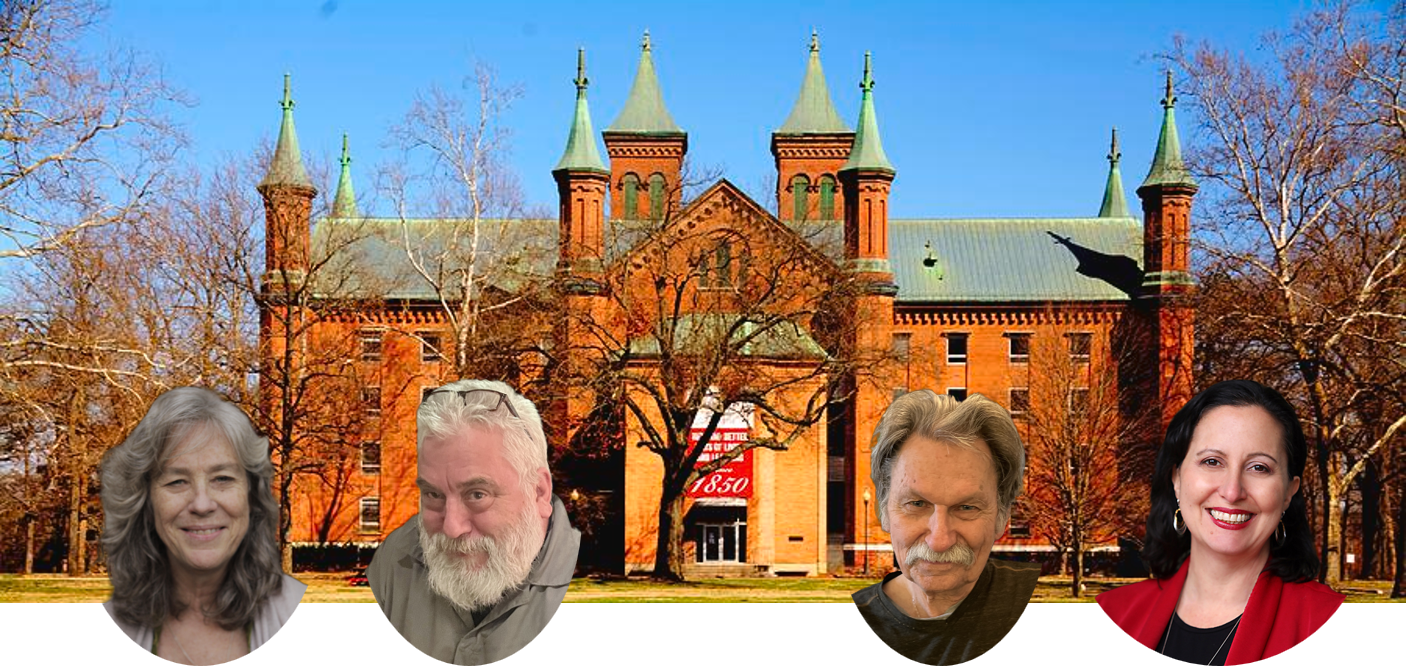
The recipients are: Wendy Ewald ’74, Michael Casselli ‘87, Gregory Orr ‘69, Michelle Moskowitz Brown ‘96
Horace Mann Award: Wendy Ewald ‘74
The Horace Mann Award recognizes contributions by alumni of Antioch College who have “won some victory for humanity”, following Horace Mann’s advice to the graduating class of 1859. Recipients are persons, or groups of persons, whose personal or professional activities have had a profound effect on the present or future human condition. Mann was the first president of Antioch College.
Born in Detroit, Michigan, Wendy Ewald was raised by socially progressive parents and came of age in the politically turbulent 1960’s. She says that “Antioch seemed perfect – in fact, the only place to go.” She entered in the fall of 1969, with still-fresh memories of the 1967 Detroit riots and already set on pursuing a career in photography, and graduated in 1974.
Looking back, Wendy says that “I never followed what I was supposed to do.” The co-op program provided space and support to begin exploring the world on her own terms. The first co-op which was arranged through a friend, took her to Labrador, Canada, where she taught photography to Innu and Mi’kmaq children. She returned every summer afterwards. A subsequent co-op took her to MIT to study with the pioneering photographer Minor White. Then on to the East Side of London, England, on her own version of AEA with her Antioch classmate and then-partner Jeff Hooper, where she founded
the Half Moon Photography Workshop. They returned to Yellow Springs to graduate.
Two years later, in 1976, she and Jeff moved to Whitesburg, Kentucky, to work with Appalshop, a media collective funded by the War on Poverty and one of ten community film workshops founded to diversify the film industry. Jeff worked with the theater department and Wendy founded the photography program. She stayed for five years.
Wendy’s next foray took her to Ráquira, Colombia, for three years on a Fulbright fellowship, where she worked with children and community groups and adopted a child. Back from Colombia, she spent nine years as a Senior Research Scholar at the Duke University Center for Documentary Studies. She went on to work internationally in India, South Africa, Saudi Arabia, Holland, Mexico, Israel, the West Bank, and Tanzania. Her projects start as documentary investigations and move on to probe questions of identity and cultural differences.
Wendy has received numerous awards including a MacArthur Fellowship, a Guggenheim Fellowship, and an Anonymous Was A Woman Artist Fellowship. Her grants also include awards from The National Endowment for the Humanities, National Endowment for the Arts, The Rauschenberg Foundation, The Open Society Institute, and The Andy Warhol Foundation, among others. She has lectured from coast to coast in the United States, in Europe, in the Middle East and Africa. To date, she has published 16 photography monographs, and a sequel will be published to Secret Games: Wendy Ewald Collaborative Works 1969-1999 – the original began with photographs from her first co-op in Labrador.
“Teaching for me is a political act- politics addresses the power or powerlessness of people in their everyday lives. I want people to understand the powers that use them and the powers they use-whether it be the power of a government or a parent or a religion. Sometimes I think I disguise myself as a teacher in order to make the pictures I need to see.”
J.D. Dawson Award: Michael Casselli ‘87
The J.D. Dawson Award recognizes significant contributions to Antioch College by alumni or friends of Antioch. The recipients of this award are persons who have contributed in a significant way to Antioch College or a program of Antioch College. Perhaps best-known for his involvement with the Co-op department, J.D. Dawson’s entire career was dedicated to Antioch College.
Michael Casselli grew up in Cleveland Heights, Ohio and attended the Cleveland Urban Learning Community — CULC. CULC had been founded by two Jesuit priests who believed that education should be rooted in community governance, experiential learning, and honest questioning of the power structures that shape our lives. Long before setting foot on campus, he was already thinking like an Antiochian.
Michael visited Antioch in 1982, completed two semesters at a Cleveland community college, enrolled at Antioch in 1983, and never looked back.
A self-designed major in Visual Arts and Performance Theory, Michael was surrounded by faculty who embodied what the arts could do: Karen Shirley, Dimi Reber, John Ronsheim, Alan Jones, Michael Jones, Gary Bower. His peer group was equally formative. They challenged each other constantly, produced, critiqued, and produced again. He found his way into community governance, coordinating AMPAC and managing Connor House — experiences that showed what it means to show up for a community, not just move through it.
Graduating in 1987, Michael was chosen as a student commencement speaker. He left Antioch carrying a deep belief in the power of shared labor, collaborative problem solving, and the recognition that the best solutions emerge when everyone is genuinely part of the process.
Michael’s career has ranged from building sets for the Great Lakes Theater Festival in Cleveland to earning an MFA in Sculpture from RISD, to Technical Director at the Kitchen in New York City, to coordinating international touring for Meredith Monk, Richard Foreman, Reza Abdoh, and Elizabeth Streb. He created pop-up performance spaces, designed sets and video installations, and pushed into new forms of fabrication and new media technology. He lived in Amsterdam and traversed Morocco.
After taking his first teaching position as Chair of Production Management and Technical Direction at CalArts in 1999, Michael joined the Antioch faculty in 2011 as a Media Arts Instructor and later received tenure teaching Sculpture and Installation. After the College closed, he actively engaged with Nonstop, then rejoined the newly opened College faculty. He served as Faculty Representative on the Board of Trustees, on the Alumni Board (elected again in 2026), Chair of the New York Alumni chapter, and actively participated in Community Council and College Council. He reviewed admissions applications, established and fund raised for an annual Alumni Art Exhibition, donated equipment and resources for student learning, mentored countless students, and trained student workers in gallery preparation, technical theater, digital fabrication, and organizational administration. He maintains strong connections to many former students, just as he reconnected with faculty after returning to Yellow Springs.
Michael says that what Antioch gave him — the belief in the power of community and individual agency, the necessity of questioning traditional structures of engagement and pedagogy, and the importance of empathy and compassion — he has spent his life giving back. He is honored to receive the J.D. Dawson Award, and profoundly grateful to this place and to all the people in it, for making him who he is.
Rebecca Rice Award: Gregory Orr ‘69
The Rebecca Rice Award recognizes alumni of Antioch College who by their actions, achievements, and leadership have distinguished themselves and their alma mater. The recipients of this award are persons who have excelled in their vocation or field of study. The award is named for the first female trustee – and longtime faculty member – of Antioch College.
Gregory (Greg) Orr transferred to Antioch after two years at a traditional college because he wanted to devote himself to writing poetry and thought creativity was more valued and nurtured at Antioch than it had been at Hamilton. A bit right and a bit wrong: Antioch didn’t have structured creative writing courses, but it did have ample room for students to design their own education. What he most needed was guidance and encouragement to design courses to educate himself in poetry.
Milton Goldberg, old school academic and William Blake (!) scholar, provided just the right blend of encouragement, skepticism, and rigor Greg needed.
Some real peer encouragement came from a fellow student poet, David Nolf. Nolf was involved in publishing “Project Pamphlets” with the Antioch Community Education Project. In August 1968, they printed Greg’s Poetry of the New Involvement: a 5 page essay about a trend in contemporary poetry to engage socially and politically (Bob Dylan, the Civil Rights Movement, Vietnam War resistance), and 24 of his own poems. Luckily, the poems were short, but still hogged ten precious pages of the pamphlet.
MFA from Columbia in 1972 and then on to the University of Virginia in 1975, where he was founder and first director of its MFA Program in Writing and served from 1978 to 2003 as Poetry Editor of the Virginia Quarterly Review. Along the way, he picked up a Guggenheim Fellowship, two poetry fellowships from the National Endowment for the Arts, and the 2003 Award in Literature by the American Academy of Arts and Letters. Greg was also a Rockefeller Fellow at the Institute for the Study of Culture and Violence, where he worked on a study of the political and social dimension of the lyric in early Greek poetry.
Early in his Antioch years, he started a daily journal of thoughts, poems, and scraps of poems. Sixty years on, he’s still writing that journal almost every morning, and it has served him well. At last count, Greg is author of fourteen collections of poetry, the most recent of which, We Interrupt This Broadcast, will be published in June 2026.
Greg is also the author of a memoir, The Blessing, which was chosen by Publisher’s Weekly as one of the fifty best non fiction books of 2002. His autobiographical essay on his experiences as a volunteer in the Civil Rights Movement, “Return to Hayneville,” was reprinted in Best Essays of 2009, Best Creative Non-fiction 2009, and Pushcart Prizes. In addition, he is the author of Poetry as Survival and A Primer for Poets and Readers of Poetry. He’s been interviewed by Krista Tippett for her “On Being” series and his personal essay was chosen to be broadcast on National Public Radio’s “This I Believe” series in the spring of 2006.
Greg is now Professor Emeritus of English at the University of Virginia. He lives with his wife, the painter Trisha Orr, in Charlottesville, Virginia.
Eleanor Holmes Norton Award: Michelle Moskowitz Brown ‘96
The Eleanor Holmes Norton Award, established in 2024, recognizes contributions by Antioch College alumni or friends who have demonstrated significant advancement in fields of policy or politics. The nominees for this award should be persons, or groups of persons, who have made positive changes through advocacy and political action, in either local, national, or global arenas, or have served in political office. The award is named for Antioch alumna Eleanor Holmes Norton, who graduated from Antioch College in 1960 and has served as the Washington, DC Delegate to Congress since 1991.
Michelle Moskowitz Brown is President and CEO at Children’s Hunger Alliance. She is driven by a commitment to building healthier communities and the belief that everyone should have the resources to eat well. However, this is not how her Antioch adventure started out.
Michelle graduated in 1996 with a BA in Arts and a self-designed major, “Anthropology of Dance.” Under the mentorship of Dimi Reber, of blessed memory, she gained a one-of-a-kind movement education. After graduation, she returned to her hometown of New York City and was immediately hired as General Manager at Dancing in the Streets, a community-based organization promoting dancers and choreographers and sponsoring free public performances. Dimi Reber first connected Michelle to the organization, where she cooped twice and organized festivals. While in New York, Michelle also worked with BRIC Arts/Media/Bklyn, and the Foundation for Jewish Culture.
A family move took Michelle to Columbus, Ohio, in 2010. She looked around, asked how people made community there, and found herself interested in food security. Her personal history of growing up in poverty, living with food insecurity and losing family members to diet-related disease, led her to shift her community organization skills into this space to effect change.
In 2011, Michelle joined Local Matters, a community organization dedicated to increasing education and access to nutritious and affordable foods, and advocating for policies to create healthier communities. She assumed the position of Executive Director in 2014. Over the next nine years, she transformed the organization into a renowned community anchor, elevating food plans alongside basic needs such as housing and transportation. She led the development of the Columbus & Franklin County Local Food Action Plan. Under her leadership, Local Matters built headquarters and a community kitchen, advocated for food benefits like SNAP, supported the growth of up-and-coming food organizations, and brought a technology enabled produce prescription program to Columbus.
Michelle joined Children’s Hunger Alliance as President and CEO in 2023, the eighth CEO in the organization’s 50 plus year history. In 2025, she led her team to provide over 10 million nutritious meals to nearly 125,000 children across Ohio in collaboration with over 1,500 partners in 76 counties. She brings her deep knowledge of Ohio’s food resources and needs to bear in providing food and nutrition education directly to children in childcare, at school, in after-school and summer programs, and at home on the weekends.
Michelle is also past chair of the Ohio Food Policy Network, a statewide coalition dedicated to a food system that supports and serves all Ohioans, and was a founding member of the Columbus & Franklin County Local Food Board. She has a Graduate Certificate in Public Management from Ohio State University’s John Glenn College of Public Affairs and completed coursework in Urban Planning at NYU’s Wagner School of Public Service.
Michelle credits her Antioch education with enhancing her critical thinking skills and her coop experience with kickstarting her career in community organization.